
- 316 and 316L usually outperform 304 and 304L in chloride-bearing environments.
- Molybdenum is the main alloying difference responsible for the stronger localized-corrosion resistance of 316 grades.
- Cold rolling improves surface quality, dimensional control, and forming consistency, but it does not change the fundamental grade family.
- 304L and 316L are preferred for welded assemblies where reduced carbon content helps limit sensitization risk.
- Correct selection still depends on chloride concentration, temperature, crevice design, cleaning practice, and surface condition.
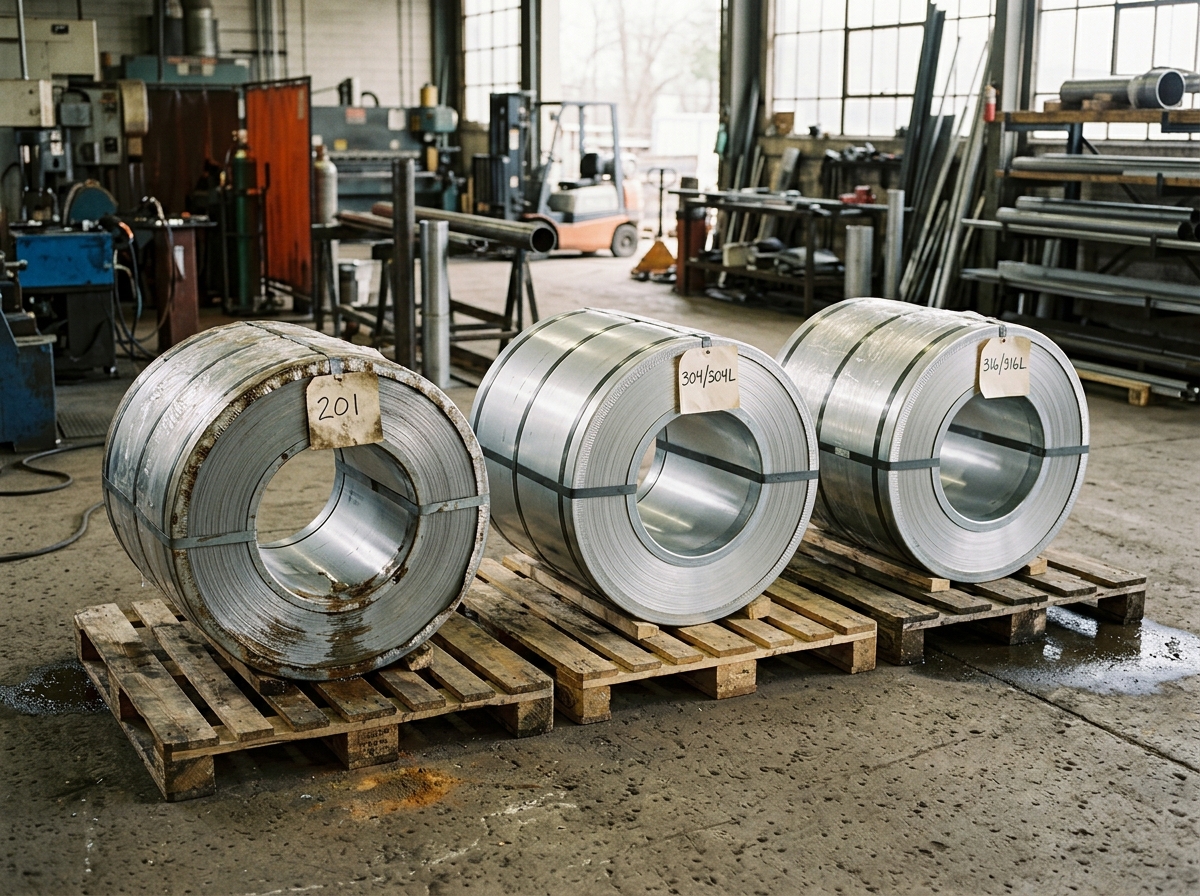
In a corrosion resistance comparison, 316 316L cold rolled stainless steel coil is the safer choice for marine, coastal, chemical, and chloride-exposed applications, while 304 304L stainless steel coil offers strong general-purpose performance at lower material cost. The British Stainless Steel Association identifies molybdenum as a key reason 316 grades provide improved resistance to pitting and crevice corrosion compared with 304 grades.
316 316L Cold Rolled Stainless Steel Coil vs. 304 304L
The central difference is alloy chemistry rather than the cold rolling process. Both families are austenitic stainless steels with good ductility, weldability, and broad forming capability. The 316 family adds molybdenum, which improves resistance to localized attack in environments containing chlorides and certain process chemicals.
304 remains the practical baseline for general corrosion resistance. It is widely selected for kitchen equipment, architectural trim, storage vessels, indoor processing equipment, and applications where exposure is mainly to moisture, air, and mild cleaning agents. 316 is normally considered when the environment is more aggressive or when the cost of premature replacement would exceed the higher initial material cost.
| Grade family | Typical chromium range | Typical nickel range | Additional alloying consideration | General selection position |
|---|---|---|---|---|
| 304 | 18.0–20.0% | 8.0–10.5% | No intentional molybdenum addition in the standard grade designation | General-purpose stainless steel |
| 304L | 18.0–20.0% | 8.0–12.0% | Low-carbon version for welded fabrication | General-purpose welded construction |
| 316 | 16.0–18.0% | 10.0–14.0% | Usually contains approximately 2.0–3.0% molybdenum | Higher resistance to localized corrosion |
| 316L | 16.0–18.0% | 10.0–15.0% | Low-carbon version with molybdenum-bearing chemistry | Welded service in more aggressive environments |
The composition ranges above are standard specification ranges and should be checked against the applicable material standard and mill certificate for the exact product. The British Stainless Steel Association comparison of 304 and 316 stainless steels explains the grade distinction and the role of molybdenum in localized-corrosion resistance.
Why Molybdenum Matters in Corrosion Resistance
Molybdenum mainly improves resistance to pitting and crevice corrosion rather than making 316 universally immune to every corrosive condition. Chloride ions can damage the passive chromium-oxide film at weak points such as scratches, deposits, welds, and narrow joints. Molybdenum helps the passive film recover and makes localized breakdown more difficult.
This distinction matters in real installations. A 316 coil formed into a poorly drained enclosure can still develop corrosion beneath deposits. A 304 coil with a clean, smooth, well-drained surface may perform better than expected in a mild environment. Grade selection and equipment design must therefore be considered together.
The International Molybdenum Association overview of molybdenum-grade stainless steels describes how molybdenum-bearing grades are used where stronger resistance to pitting and crevice corrosion is required.
Corrosion Resistance Comparison by Service Environment
316 is most valuable when the exposure combines chlorides, moisture retention, and elevated temperature. Temperature, concentration, evaporation, and surface contamination can all change the result, so a simple grade label cannot replace application review.
| Service environment | 304 or 304L suitability | 316 or 316L suitability | Primary risk to review | Selection guidance |
|---|---|---|---|---|
| Dry indoor equipment | Usually suitable | Usually suitable | Condensation and cleaning chemicals | 304 is often sufficient |
| Food and beverage processing | Commonly suitable | Useful for salt or chemical exposure | Deposits, crevices, and sanitation chemicals | Choose by cleaning regime and chloride exposure |
| Coastal atmosphere | May require frequent cleaning | Generally offers greater margin | Salt deposits and wet-dry cycles | 316 is often preferred for exposed components |
| Direct seawater contact | High risk of localized corrosion | Still requires engineering review | Pitting, crevice corrosion, and biofouling | Do not treat 316 as a universal seawater solution |
| Acidic process service | Performance varies widely | May be better, but not automatically suitable | Acid type, concentration, and temperature | Use compatibility data or corrosion testing |
| High-temperature chloride exposure | Often unfavorable | Improved but application-dependent | Chloride concentration and thermal cycling | Obtain specialist materials advice |
For atmospheric environments, surface maintenance can be as important as grade selection. Salt, iron contamination, process residue, and stagnant water can create local corrosion cells on either grade. Cleaning should remove deposits without introducing carbon-steel contamination or damaging the passive surface.
Cold Rolled Coil: What Changes and What Does Not
Cold rolling primarily improves the manufacturing characteristics of the coil, not its basic chemical resistance category. It can provide a smoother surface, tighter thickness control, improved flatness, and more consistent strip dimensions for slitting, precision stamping, bending, and automated feeding.
A cold rolled 304L coil is still a 304L alloy, and a cold rolled 316L coil is still a 316L alloy. Surface finish, work-hardening condition, annealing, and final pass reduction can influence forming behavior and practical corrosion performance, but they do not eliminate the underlying difference between molybdenum-free 304 and molybdenum-bearing 316.
| Procurement factor | Why it matters | Questions to ask the supplier |
|---|---|---|
| Grade | Defines baseline chemistry and corrosion behavior | Is the material 304, 304L, 316, or 316L? |
| Surface finish | Influences appearance, cleaning, friction, and deposit retention | Is the requested finish 2B, BA, matte, or customized? |
| Temper | Changes forming response, springback, and strength | Is the coil annealed, soft, half-hard, or hard? |
| Slit width | Determines compatibility with stamping, winding, and assembly equipment | What finished width and edge condition are required? |
| Traceability | Supports quality control and application accountability | Will the coil include heat, batch, and inspection documentation? |
| Packaging | Protects the surface during transport and storage | Are paper interleaving, film, and moisture controls needed? |
304L or 316L for Welded Cold Rolled Components?
The L grades are generally selected when welding is part of the fabrication route. Their reduced carbon content lowers the risk of chromium carbide precipitation in the heat-affected zone, helping preserve intergranular corrosion resistance when the welding procedure and service conditions are appropriate.

316L is not automatically the correct choice for every welded assembly. If the finished component remains in a mild indoor environment, 304L may provide adequate performance with easier cost control. If welds will face salt spray, cleaning chemicals, or chloride-bearing condensate, 316L provides a stronger material starting point, but weld design, shielding, heat input, post-weld cleaning, and drainage remain essential.
How to Choose Between 304 304L and 316 316L Coil
The best choice is the least expensive grade that provides a defensible corrosion margin for the complete service life. Use this decision sequence before requesting a quotation:
- Identify the actual contaminants, including chlorides, acids, alkaline cleaners, sulfur compounds, and metal residues.
- Record operating temperature, wet-dry cycling, condensation, immersion, and whether deposits can accumulate.
- Review the component design for crevices, lap joints, threaded areas, welds, sharp edges, and poor drainage.
- Match the grade to the forming route, required surface, temper, thickness, width, and slit-edge condition.
- Request a material certificate and confirm the applicable specification, inspection requirements, and traceability.
- Use laboratory testing, published compatibility data, or specialist review when failure consequences are high.
Choose 304 or 304L when the environment is mainly atmospheric, clean, and low in chlorides, and when the project benefits from lower material cost. Choose 316 or 316L when chloride exposure, coastal contamination, chemical residue, or wet crevices creates a meaningful risk of localized corrosion. For severe immersion, concentrated chemicals, or elevated-temperature process service, compare additional alloys rather than assuming 316 is sufficient.
Common Selection Mistakes
- Assuming a polished appearance proves superior corrosion resistance.
- Choosing 316 solely because the application is outdoors without checking chloride exposure or drainage.
- Using 304 in a salt-contaminated crevice and expecting routine cleaning to remove all risk.
- Comparing nominal grade names without confirming carbon level, surface condition, temper, and mill documentation.
- Ignoring contamination from carbon-steel tools, storage racks, or fabrication equipment.
FAQ
Is 316 always more corrosion resistant than 304?
No. 316 generally provides better resistance to chloride-induced pitting and crevice corrosion, but performance depends on concentration, temperature, deposits, surface condition, design, and maintenance. Some environments require a different alloy or a non-metallic solution.
Is 316L better than 316 for corrosion resistance?
316L is mainly the low-carbon version of 316. Its principal advantage is improved resistance to sensitization during welding. In an unwelded component, the corrosion difference may be limited when both materials meet their specifications.
Is 304L suitable for coastal applications?
It can be suitable in sheltered or regularly cleaned locations with limited salt deposition. Exposed coastal components, especially those that retain moisture, usually need a more conservative review and may favor 316L.
Does cold rolling make stainless steel more corrosion resistant?
Cold rolling mainly improves dimensional accuracy, flatness, surface quality, and production consistency. Corrosion performance remains primarily governed by alloy chemistry, surface condition, fabrication quality, and the service environment.
Which grade is easier to form?
Both grades have good forming capability, but the exact result depends on thickness, temper, reduction, tool design, radius, and work hardening. A supplier should confirm the mechanical condition for deep drawing, bending, or precision stamping.
Which grade is more economical?
304 and 304L are normally more economical because 316 and 316L contain molybdenum and typically require a higher alloy cost. The correct comparison should include cleaning, replacement, downtime, and failure consequences rather than purchase price alone.
What documents should be requested for stainless steel coil?
Request the applicable material specification, heat or batch identification, chemical analysis, mechanical test results where required, surface and dimensional inspection records, and confirmation of the agreed finish, temper, width, thickness, and edge condition.
About the Supplier
Wow Stainless supports stainless steel coil and strip sourcing for industrial, precision manufacturing, automotive, electronic, architectural, and fabrication applications. Its capabilities can include cold rolled material, precision slitting, surface finishes, temper control, protective packaging, and application-oriented specification review. Buyers can discuss grade selection, dimensions, documentation, and customization requirements before placing an order.

Post time: Sep-08-2026


