
- SH (full hard) temper can produce 5-8° of spring-back in austenitic stainless — die geometry must compensate, or your tolerances fail.
- The precision cold rolled stainless steel category spans 1/4H to SH, with 1/4H being the most forgiving and SH the most spring-back-prone.
- Cold rolled stainless steel coils for stamping programs typically use SUS301 (work-hardening) or SUS304 (general-purpose), selected by temper grade.
- Thickness tolerance ±0.005mm is the baseline for precision stamping die clearance; looser tolerances force over-clearance and increase spring-back variance.
- Verify temper via mill test certificate per ASTM A666 — never by hardness spot-check alone.
The conversation about spring-back in stamping dies almost always starts too late. The die is built, the sample run is on the floor, and the first hundred pieces come out 2-3° off-angle from the design geometry — and that’s when someone asks the temper grade question. Spring-back is a function of the temper grade, the strain distribution in the part geometry, and the die clearance window — but temper is the variable that stamping engineers control through material specification, not die geometry.
For austenitic stainless strip — the precision cold rolled stainless steel category most stamping programs use — temper grades run from 1/4H (annealed, low yield strength, minimal spring-back) to SH (full hard, high yield strength, maximum spring-back). SH temper can produce 5-8° of spring-back on a typical 90° bend in 0.5mm-1.0mm strip thickness, which sounds modest until you realize that most precision stamped parts have angle tolerances of ±0.5° to ±1°.
The choice between 1/4H, 1/2H, 3/4H, FH, and SH is not a material upgrade path — it is a design decision that locks in spring-back compensation early. Die designers who specify temper at the part-design stage save themselves from die rework at the sampling stage, and that’s the entire conversation our cold rolled stainless steel coils program is built around. The temper grade you order determines the die geometry you need to cut.
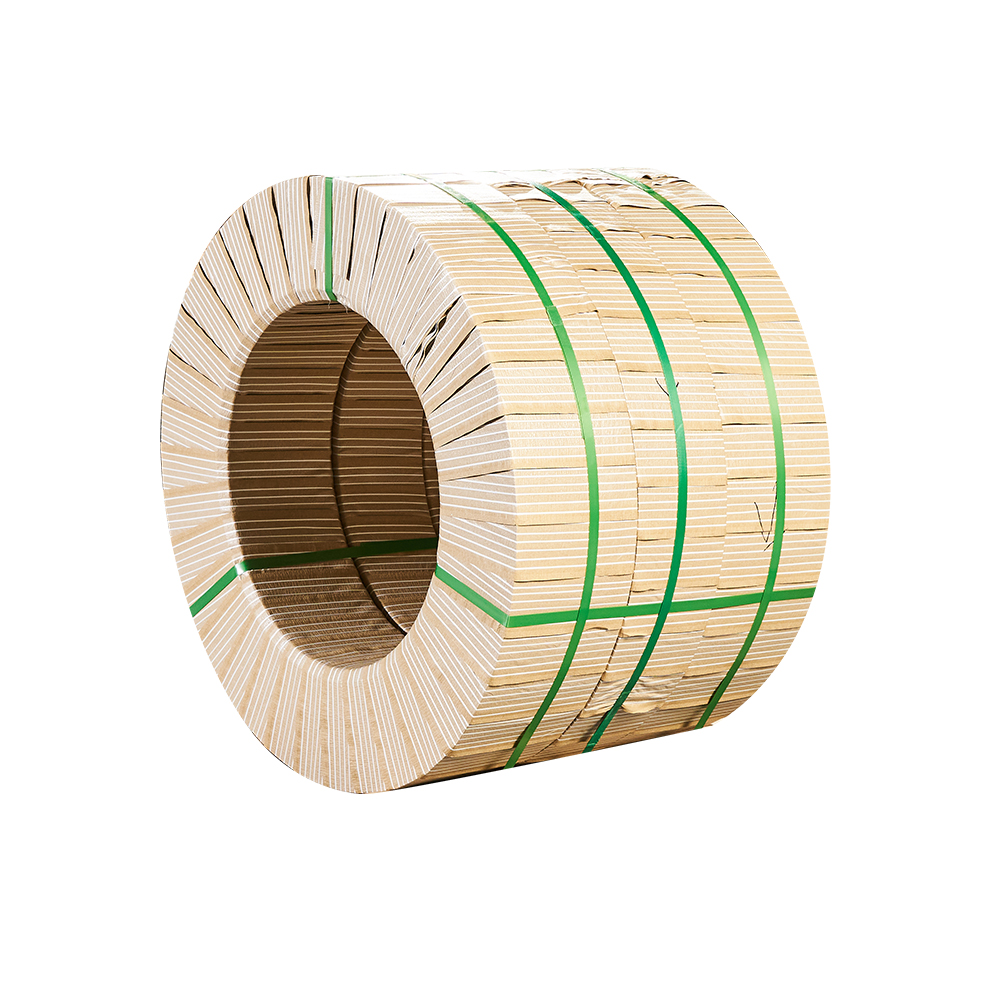
Precision cold rolled stainless steel coil/strip — temper grades 1/4H to SH, available for industrial OEM stamping programs. View product →
The Spring-Back Problem Stamping Engineers Don’t Talk About Until Production
Spring-back is the elastic recovery of metal after a stamping operation removes the forming load. When a press bends a strip to a 90° die angle, the metal wants to spring back toward its original flat state once the load releases, and the magnitude of that recovery is governed primarily by the yield strength of the material at the bend zone. Higher yield strength means more elastic energy stored in the deformation, which means more spring-back when the load releases.
For austenitic stainless strip, the temper grade is the primary lever that controls yield strength. Annealed (1/4H and softer) material has yield strength in the 200-350 MPa range, which produces modest spring-back that most engineers handle with a 1-2° overbend. SH (full hard) temper pushes yield strength into the 1000-1300 MPa range, which stores enough elastic energy to produce 5-8° of recovery on a typical 90° bend.
Why does this conversation always start at production rather than at design? Because temper grade is invisible on a print. A stamped part drawing specifies geometry and tolerances, but rarely specifies the temper grade — that decision is typically left to the material supplier or the stamping buyer. The result is that die geometry gets cut based on assumed spring-back, and the assumption gets stress-tested only when the first parts come off the press. The fix is upstream: specifying temper at the part design stage, before the die is cut.
Decoding the Temper Code: What 1/4H, 1/2H, 3/4H, FH, and SH Actually Mean to a Die Designer
Temper designations for austenitic stainless strip follow ASTM A666, which defines mechanical property ranges for each grade. The codes are shorthand for the amount of cold work applied during the rolling process, with each step up the scale representing incrementally higher yield strength and lower elongation.
| Temper Code | Typical Yield Strength | Typical Spring-Back (90° bend, 0.5-1.0mm SUS304) | Typical Application |
|---|---|---|---|
| 1/4H (quarter hard) | 350-450 MPa | 1-2° | Deep draw, complex forming |
| 1/2H (half hard) | 500-700 MPa | 2-3° | Moderate forming, general stamping |
| 3/4H (three-quarter hard) | 700-900 MPa | 3-5° | Structural stamping, retainers |
| FH (full hard) | 900-1100 MPa | 4-6° | Flat springs, high-strength formed parts |
| SH (spring / extra hard) | 1100-1300+ MPa | 5-8° | Spring clips, contact strips |
For die designers, the practical question is which temper achieves the required final-part strength while keeping spring-back within a manageable compensation range. A 1° tolerance on a 90° bend requires overbend compensation accurate to ±0.5°, which is achievable with 1/4H and 1/2H but progressively harder as you climb to FH and SH. Programs targeting ±0.5° tolerance on stamped parts typically specify 1/2H or 3/4H, not higher.
The trap to avoid is specifying temper based on final-part strength requirements without checking spring-back against tolerance. A part that needs 1000 MPa tensile strength after forming can reach that strength with 1/4H material that work-hardens during the stamping process (especially with SUS301), without paying the spring-back penalty of FH temper. The right temper is the one that achieves the strength target with the lowest spring-back, not the highest yield strength on the mill cert.
Austenitic vs Ferritic: Why SUS304, SUS301, and SUS430 Behave Differently Under the Press
The temper code is one axis of stainless selection. The alloy family is another, and it changes spring-back behavior more than most engineers expect. Austenitic stainless (SUS304, SUS301, SUS316) work-hardens during forming, which means the actual yield strength at the bend zone is higher than the as-received mill cert would suggest. Ferritic stainless (SUS430, SUS409) does not work-harden significantly, which means spring-back behavior is more predictable from the mill cert values.
SUS301 is the work-hardening champion of the austenitic family. A 1/4H SUS301 strip can end up at FH strength in the formed zone after a single stamping pass, which is why SUS301 is the standard choice for spring-like stamped components that need high final strength. The trade-off is that spring-back compensation for SUS301 is harder to predict because the work-hardening curve depends on the specific strain path in the part geometry.
SUS304 has a more moderate work-hardening rate than SUS301, which makes it the easier grade to control in stamping programs that need predictable spring-back. Most general-purpose precision stamping programs default to SUS304 for this reason, even when SUS301 could theoretically deliver higher final strength.
Ferritic SUS430 sits in a different category entirely. It does not work-harden significantly, which means the spring-back is essentially a function of the as-received temper and the bend geometry. For programs where spring-back predictability matters more than final-part strength, ferritic SUS430 can actually be the better engineering choice, even though it carries a lower strength ceiling than austenitic grades.
The practical selection logic:
- SUS301 for spring-like components, contact strips, high-strength formed parts where work-hardening is a feature
- SUS304 for general precision stamping where predictable spring-back matters more than maximum final strength
- SUS316L for corrosion-critical applications (medical, marine, chemical) where the cost premium is justified
- SUS430 for cost-sensitive programs with moderate strength requirements and predictable forming behavior
Thickness Tolerance at 0.05mm: Where Precision Cold Rolling Meets the Die Clearance Window
Thickness tolerance and spring-back interact through the die clearance specification. A die is cut with a clearance gap between the punch and die set, sized to the strip thickness plus a small allowance. If the strip varies in thickness, the clearance varies, which changes the strain distribution at the bend, which changes spring-back. The looser the strip thickness tolerance, the wider the die clearance must be, and the wider the clearance, the more variable the spring-back.
For precision stamping programs, the practical tolerance bands break down into three tiers:
| Tolerance Tier | Thickness Range | Typical Application |
|---|---|---|
| Standard tolerance | ±0.02-0.05mm | General stamping, non-precision parts |
| Precision tolerance | ±0.005-0.015mm | Precision stamping, tight angle tolerance |
| Ultra-precision tolerance | ±0.002-0.005mm | Connector stamping, electronics-grade parts |
Programs that try to save cost by ordering standard-tolerance coil for a precision-tolerance stamping program end up paying for it in die clearance adjustments and spring-back variance. The right specification is to order coil at a tolerance that matches the die clearance target, not at the loosest tolerance the mill will accept. For most precision stamping programs, ±0.01mm is the practical baseline.
For ultra-thin strip (under 0.1mm), thickness tolerance becomes even more critical because the proportional effect on die clearance is larger. Programs working with 0.05-0.1mm strip typically need ultra-precision tolerance and tighter process control on incoming material inspection.
Case Data From Three Production Programs — What Actually Failed and Why
Three production programs from our recent book illustrate how temper specification plays out in the real world, and where the engineering decisions either held up or required rework.
Program 1: Battery contact strip, 0.3mm SUS301 FH temper. The original specification called for 1/2H SUS301 based on the assumption that work-hardening during stamping would push the formed zone to sufficient strength. First-article samples came back at 95% of the required strength, not 100%. The fix was re-specifying to FH temper, accepting the additional spring-back penalty, and adding 4° of overbend to the die geometry. Final parts met both strength and angle tolerance. Lesson: mill cert strength is not the same as stamped-strip strength, especially for work-hardening grades.
Program 2: Automotive bracket, 1.2mm SUS304 1/2H temper. The program spec called for standard tolerance ±0.03mm coil. Spring-back variance in production came in at ±1.5° around the target, which exceeded the ±0.5° part tolerance. Root cause was thickness variation across the coil forcing wider die clearance. Fix was re-specifying to precision tolerance ±0.01mm coil and tightening die clearance. Spring-back variance dropped to ±0.4°. Lesson: thickness tolerance is a spring-back control, not just a dimensional control.
Program 3: Electronic connector, 0.15mm SUS304 SH temper. The SH temper was specified for spring-like end-use, and the die was cut with 8° overbend to compensate. First samples came back 1° short of target angle consistently. Investigation showed the SH temper was actually 3/4H based on incoming yield strength testing. The mill cert was correct, but the as-received coil had been re-tempered during slitting, which reduced the effective temper. Fix was re-validating incoming temper per ASTM A666 mechanical property testing, not just mill cert review. Lesson: verify temper on incoming coil, do not assume the mill cert covers the slit-width product.
Sourcing Precision Stainless Strip for Industrial OEM Programs
For procurement teams sourcing precision stainless strip for stamping, the specification conversation needs to cover six items before the PO is released. These are not optional documentation — they are the inputs that determine whether the stamping program will hit tolerance on the first sampling run or require die rework.
- Alloy designation — SUS301, SUS304, SUS316L, SUS430, or other, with mill cert traceability
- Temper grade per ASTM A666 — 1/4H, 1/2H, 3/4H, FH, or SH, with mechanical property ranges
- Thickness range and tolerance — typical range 0.05-3.0mm, tolerance tier per the die clearance requirement
- Width and slit tolerance — slit width is often where incoming temper drifts from mill cert
- Surface finish — 2B, BA, or polished, depending on end-use application
- Edge condition — slit edge, deburred edge, or rounded edge, depending on feed system requirements
Our [precision cold rolled stainless steel coil](https://www.wowstainless.com/precision-cold-rolled-stainless-steel-coil/) program covers austenitic (304, 301, 316L) and ferritic (430, 409) grades with temper grades from 1/4H to SH, slit to width with verified mechanical properties on the slit product. The [cold rolled stainless steel coils](https://www.wowstainless.com/cold-rolled-stainless-steel-coils/) category covers broader industrial applications where temper specification is less critical.
For OEM programs where spring-back control matters, we recommend ordering sample coils with mill cert verification before committing to production volumes, because spring-back behavior is sensitive to the specific temper profile of each production batch. Programs that skip this step typically encounter the spring-back surprise at the first production run, which is the most expensive point in the program timeline to discover it.
Request a Temper Specification Consultation
Industrial OEM buyers and stamping engineers can request sample coils, mill cert review, and temper specification support through our precision stainless steel category.
Frequently Asked Questions
What does 1/4H, 1/2H, 3/4H, FH, and SH temper mean for stainless steel strip?
These are temper designations defined in ASTM A666 for austenitic stainless steel strip. 1/4H is quarter-hard (light cold work, annealed-like formability), 1/2H is half-hard, 3/4H is three-quarter hard, FH is full hard, and SH is extra-hard / spring temper. As you move from 1/4H to SH, yield strength rises significantly while elongation drops. The practical effect in stamping is that spring-back increases with each step up the temper scale, requiring larger die bend angles to achieve the final part geometry.
How much spring-back should I expect from each temper grade?
For 0.5-1.0mm austenitic stainless strip on a typical 90° bend, expected spring-back is approximately 1-2° at 1/4H, 2-3° at 1/2H, 3-5° at 3/4H, 4-6° at FH, and 5-8° at SH. These are field-typical ranges from production data, not theoretical minimums. Actual spring-back varies with bend radius, grain direction, and press speed, which is why production trials always measure and adjust.
Should I choose SUS301 or SUS304 for a precision stamping program?
SUS301 has higher work-hardening rate than SUS304, which means it strengthens faster during the stamping process and is the preferred grade for spring-like components that need high final strength. SUS304 has more banced formability and is the general-purpose choice for less aggressive forming. For deep draw or complex multi-stage stamping, SUS304 is typically easier to control. For flat spring, clip, or high-strength formed parts, SUS301 typically delivers better performance.
What thickness tolerance is required for precision stamping?
Precision stamping dies typically require thickness tolerance of ±0.005mm to ±0.01mm depending on part geometry and die clearance. Loose thickness tolerance forces wider die clearance, which increases spring-back variance because the strain distribution becomes less predictable. Precision cold rolled stainless steel coil to ±0.005mm is the baseline for high-tolerance stamping programs; looser coil may be acceptable for non-precision parts.
What is ASTM A666 and why does it matter?
ASTM A666 is the standard specification for austenitic stainless steel sheet, strip, plate, and flat bar for structural and architectural applications. It defines the temper grade designations (1/4H through SH), mechanical property ranges, and testing methodology. Verifying ASTM A666 compliance via the mill test certificate is the baseline assurance that the temper grade you ordered matches the temper grade you received.
Does spring-back change with strip thickness?
Yes. Thinner strips generally show proportionally larger spring-back angles because the strain distribution across the cross-section is more uniform in thin material, while thicker strips distribute strain unevenly and behave more like a bending beam. For 0.1-0.3mm ultra-thin strip, spring-back compensation curves differ significantly from 1.0-2.0mm standard strip. Programs switching between thickness ranges must revalidate die geometry, not assume the same compensation applies. Cold-rolled stainless steel flat products technical delivery conditions follow the EN 10088-2 stainless steel flat products European standard, which complements ASTM A666 for international procurement programs. Press safety standards for mechanical stamping equipment reference ISO 16092-1 mechanical press safety, and stainless steel composition references for general purposes are documented in ISO 16143-1 stainless steel composition.
Post time: Aug-18-2026


