
- SS201, SS304, SS316 form a tiered answer to one question: how much chloride and what peak temperature will the exhaust flexible pipe see in service?
- SS201 saves material cost in indoor, dry, mild-temperature applications where chloride is absent — typically indoor industrial and decorative exhaust.
- SS304 is the default for general road-going automotive and industrial exhaust in non-marine, non-de-icing-salt regions.
- SS316 is the only safe choice for marine, coastal, road-salt-heavy, and chemical-exposure exhaust — the 2–3% molybdenum addition resists chloride pitting.
- For welded exhaust assemblies, specify SS316L (low carbon) or SS316Ti (titanium stabilized) to suppress chromium-carbide precipitation at the weld heat-affected zone.
Why Exhaust Pipes Are a Special Case for Stainless Selection
Exhaust flexible pipes sit in one of the more aggressive service environments a stainless steel part can occupy. The combination of thermal cycling, acidic condensate, road salts, and mechanical vibration discriminates between grades faster than almost any other application in industrial or automotive use.
Four corrosion mechanisms act on an exhaust flexible pipe at the same time:
- Acidic condensate corrosion. Combustion produces carbonic and sulfuric acids in the condensate that forms on the pipe wall during cool-down. The condensate collects at the bellows convolutions, where the geometry holds moisture longest.
- High-temperature oxidation. The pipe cycles between ambient and several hundred degrees Celsius. Oxidation kinetics accelerate above 600°C, and only the chromium oxide layer on stainless resists this attack.
- Chloride pitting. Where the exhaust pipe runs cold (rear sections, cold-start, marine and road-salt environments), chloride ions attack the passive layer and produce localized pits that grow into through-wall perforations.
- Vibration-induced fatigue. The bellows convolutions flex with every engine cycle. Pits become fatigue crack initiators; the combination of chloride pitting and cyclic stress is the most common failure mode in service.
Of these four mechanisms, chloride pitting is the one that separates 201, 304, and 316. The other three are similar across the 200/300 family; chloride resistance is the grade decision.
Composition & Corrosion Mechanism — What Actually Differs Between the Three Grades
The grade decision for exhaust flexible pipes is driven by chromium, nickel, manganese, and molybdenum content. Carbon is the secondary concern, particularly for welded assemblies.
| Element | SS201 | SS304 / 304L | SS316 / 316L | SS316Ti |
|---|---|---|---|---|
| Chromium (Cr) | 16–18% | 18–20% | 16–18% | 16–18% |
| Nickel (Ni) | 3.5–5.5% | 8–10.5% | 10–14% | 10–14% |
| Manganese (Mn) | 5.5–7.5% | ≤2.0% | ≤2.0% | ≤2.0% |
| Molybdenum (Mo) | — | — | 2–3% | 2–3% |
| Nitrogen (N) | ≤0.25% | ≤0.10% | ≤0.10% | ≤0.10% |
| Carbon (C) | ≤0.15% | ≤0.08% (L: ≤0.03%) | ≤0.08% (L: ≤0.03%) | ≤0.08% |
| Titanium (Ti) | — | — | — | ≥5×C (stabilized) |
Three of these rows drive the grade decision:
- Molybdenum (Mo) — present in SS316 and SS316Ti, absent in SS201 and SS304. This is the single line that separates 316 from 304 in chloride service. Mo stabilizes the passive layer against chloride attack.
- Nickel (Ni) — the austenite stabilizer. SS201 substitutes manganese for some of the nickel content, which is why 201 costs less than 304. The lower nickel reduces austenite stability, which has knock-on effects on formability, deep-drawing, and corrosion.
- Carbon (C) — for welded assemblies, the L-grade (low carbon) variant or the Ti-stabilized variant is preferred to suppress chromium-carbide precipitation at the weld heat-affected zone.
SS201 — Where It Saves Money and Where It Bites Back
SS201 is the cost-rational choice when the exhaust pipe runs hot, dry, and never sees chloride. It is the same austenitic family as 304, but with manganese and nitrogen substituting for some of the nickel. That metallurgical shortcut is what makes 201 cheaper; it is also what limits where 201 can be used.
SS201 is appropriate for:
- Indoor industrial exhaust — factory stacks, ventilation ducting, indoor generator exhaust where condensate drains quickly and chloride is absent.
- Decorative exhaust trim — visible exhaust tips and accents on show vehicles and indoor display exhaust. Chloride exposure is minimal; the part is selected for appearance and cost.
- Dry-climate road exhaust — vehicles operated exclusively in arid regions with no road salt, no marine exposure, and short ownership cycles. The service life of 201 in this environment can be acceptable.
- Non-load-bearing bellows geometry — where the bellows geometry is sized for vibration absorption only and is not exposed to thermal cycling extremes.
SS201 fails predictably in chloride service. The first sign is pitting on the bellows convolutions where condensate collects during cool-down. Within a few thousand miles, the pits grow into through-wall perforations, and the part fails at the convolution, not the weld.
SS304 — The Default That Most Buyers Should Specify
SS304 is the workhorse of the stainless exhaust industry. The 18% chromium, 8% nickel composition gives general corrosion resistance sufficient for most road-going automotive exhaust, light industrial exhaust, and HVAC applications.
SS304 is appropriate for:
- General road-going automotive exhaust — passenger vehicles, light trucks, motorcycles. SS304 is the typical specification for OEM and aftermarket exhaust components.
- Light industrial exhaust — small engine exhaust, generator exhaust, compressor exhaust in non-marine environments.
- Hydronic and HVAC exhaust — boiler flues, water heater exhaust, low-temperature process exhaust.
- Replacement parts for legacy 304 systems — where the system was designed around 304, mixing grades is acceptable only when the replacement is in the same corrosion environment.
SS304 is the default specification that solves most problems without overpaying. Where it fails is chloride exposure: road salt in northern winters, marine atmosphere, chemical processing exhaust streams. SS304 has no molybdenum, so chloride ions break through the passive layer and pit. The pitting is slow at first — visible only after years of service — but accelerates once pits nucleate.
SS304 also fails in welded assemblies where the heat-affected zone sees sustained temperatures in the 425–860°C sensitization range. Chromium carbides precipitate at the grain boundaries, depleting the surrounding area of chromium. The result is intergranular corrosion that runs along the weld HAZ, not across it. This is the failure mode that the L-grade and Ti-stabilized variants are designed to suppress.
SS316 — When It Is the Only Right Answer
SS316 is the marine-grade austenitic stainless steel, and the 2–3% molybdenum addition is what makes the difference. Molybdenum stabilizes the passive oxide layer against chloride attack, raising the pitting resistance equivalent number (PREN) and pushing the chloride-driven failure threshold well above what SS304 can survive.
SS316 is appropriate for:
- Marine exhaust — boat, ship, and offshore platform exhaust. Marine atmosphere is continuously chloride-rich.
- Coastal road exhaust — vehicles operated within a few kilometers of saltwater coastlines. Airborne chloride deposits on cold pipe sections during overnight cooling.
- Road-salt-heavy regions — northern North America, northern Europe, the northern United Kingdom, parts of central and eastern Europe, and any region that uses chloride de-icing. The chloride deposits accumulate on the underbody and migrate to the exhaust system via splash and road spray.
- Chemical and process exhaust — applications where the exhaust stream contains acidic, alkaline, or chloride-bearing vapors.
- High-end OEM exhaust — premium vehicle and motorcycle exhaust systems where the manufacturer has lifetime or long warranty exposure on the part.
Decision Matrix — By Environment
The table below is a working reference for grade selection by service environment. It is not exhaustive; it covers the patterns we see most often.
| Service Environment | Recommended Grade | Welded Variant | Why |
|---|---|---|---|
| Indoor industrial exhaust, dry | SS201 or SS304 | 304L for welded assemblies | No chloride, mild temperature; 201 saves cost |
| Decorative exhaust trim, indoor | SS201 or SS304 | 304L for welded assemblies | Aesthetic + cost-driven; no chloride exposure |
| Road-going automotive, no road salt | SS304 | 304L for welded assemblies | General road exhaust; no chloride |
| Road-going automotive, winter road salt | SS316 | 316L | Road-salt chloride exposure |
| Coastal road exhaust (within a few km of saltwater) | SS316 | 316L | Marine atmosphere deposits chloride |
| Marine vessel exhaust | SS316 | 316L | Continuous marine chloride |
| Offshore platform exhaust | SS316 | 316L or 316Ti | Severe chloride plus elevated temperature |
| Chemical / process exhaust, acidic vapors | SS316 | 316L | Acid resistance plus chloride resistance |
| High-temperature exhaust (above 800°C sustained) | SS321 or SS316Ti | 316Ti | Stabilized for high-temperature service |
| Heavy industrial, abrasive + chloride | SS316 + duplex 2205 (select features) | 316L or 2205 | Duplex for high-stress, chloride-rich areas |
The L and Ti Variants — When the Weld Zone Matters
Standard SS304 and SS316 both have a maximum carbon content of 0.08%, which is enough to cause chromium-carbide precipitation at the weld heat-affected zone. When the HAZ sits in the 425–860°C sensitization range during welding, chromium combines with carbon at the grain boundaries, depleting the surrounding area of chromium and leaving it vulnerable to intergranular corrosion.
The fix is one of two metallurgical workarounds:
- L-grades (304L, 316L) reduce maximum carbon to 0.03%, which is below the solubility threshold for chromium carbide. With insufficient carbon, the sensitization reaction cannot proceed.
- Ti-stabilized (321, 316Ti) adds titanium at five times the carbon content. Titanium combines with carbon preferentially, leaving chromium in solution and preserving corrosion resistance at the HAZ.
For welded exhaust assemblies, the choice is between 316L (the most common) and 316Ti (preferred for sustained high-temperature service). 316L is the default for marine welded exhaust; 316Ti is the upgrade for marine welded exhaust that also sees sustained temperatures above 600°C.
Inside the Wowstainless Material Program — Mr. Chen’s View
My name is Mr. Chen, and I lead technical work at Wowstainless. Most of my week is spent matching stainless grades to customer exhaust applications, so let me share how we approach the 201/304/316 question.
Material selection on exhaust flexible pipes is not a one-grade-fits-all decision. The same bellows geometry is produced in 201, 304, 316, 316L, 316Ti, and occasionally 321, depending on what the customer is connecting it to and where the assembly lives in service. The metallurgical range on offer is wider than most buyers realize.
Three rules I apply when a customer asks for grade advice:
1. Lead with the environment, not the price
The conversation usually opens with a price target. That is the right place to start, but it is the wrong place to end. A buyer who is comparing 201 and 304 by price alone is missing the chloride exposure question, which is the variable that decides whether the part lasts one winter or ten. Get the environment right, and the grade selection usually falls out naturally.
2. The L-grade is the default for welded assemblies
Most exhaust flexible pipe assemblies are welded somewhere — at the inlet, at the outlet, or at an interlock joint. For welded assemblies, the L-grade is the engineering default, not an upgrade. We stock 304L and 316L for the same reason we stock 304 and 316: because the welded configuration is the common configuration. Specifying standard 304 or 316 for a welded exhaust assembly is leaving corrosion resistance on the table.
3. Mill certificates matter as much as the grade callout
A 316L callout on the drawing is only as good as the mill certificate that ships with the coil or strip. We work with Baoxin, Zhangpu, TISCO, and Lianzhong as the upstream material sources, and we verify heat-number chemistry on every lot. The grade on the spec sheet is the engineering promise; the certificate is the proof.
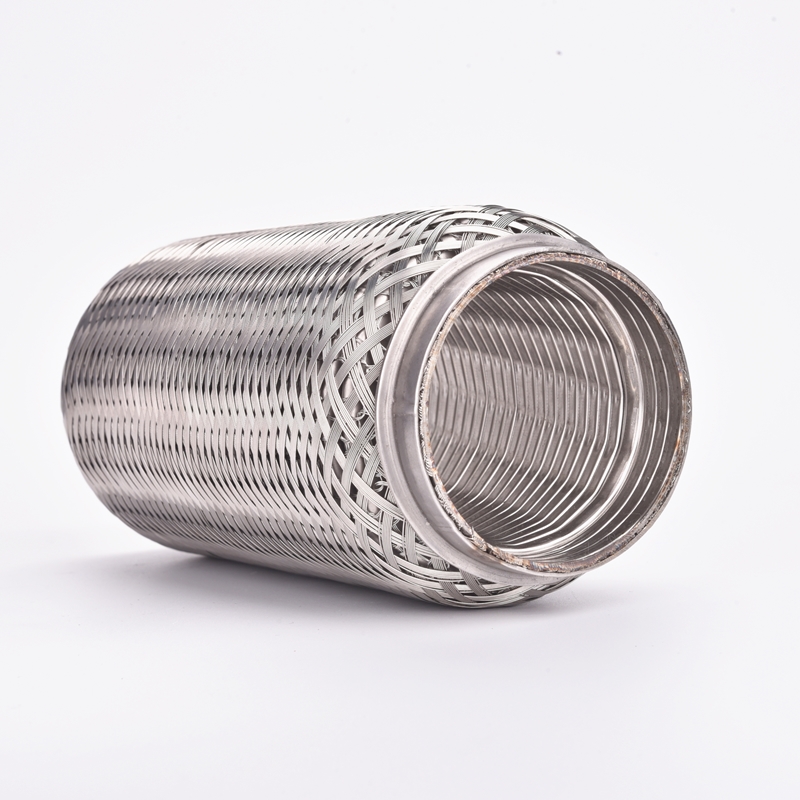
For buyers who want a quick sanity check on their specification, the Wowstainless exhaust flexible pipes range covers unlined, with-inner-braid, with-interlock-and-outer-braid, with-connection-tube, and with-extension-tube variants across the full 201 / 304 / 316 / 316L / 316Ti material range. The flexible pipe with inner braid is the most commonly specified variant for road-going applications, where the inner braid adds mechanical reinforcement against vibration fatigue on top of the corrosion-resistance of the base grade.
How to Specify the Grade on a Purchase Order
For buyers writing a PO or RFQ, four documentation items make the grade decision enforceable:
- AISI designation. Specify the grade by the AISI numbering system (201, 304, 304L, 316, 316L, 316Ti) — not by trade name or generic “stainless.”
- Applicable ASTM specification. Reference the ASTM spec that governs the form (plate, sheet, strip, tube). ASTM A240 for plate/sheet, ASTM A269 for general-service tubing, ASTM A554 for mechanical tubing.
- Welded-assembly note. If the part is welded during fabrication, specify the L-grade or Ti-stabilized variant. Do not leave this to the foundry’s discretion.
- Mill certificate request. Ask for the mill heat-number certificate with the shipment so chemistry can be verified against the callout on the first article.
Once the specification is clear, the Wowstainless engineering team can quote against the same material callout, with full traceability from coil to finished flexible pipe.
Frequently Asked Questions
1. Is SS201 acceptable for exhaust flexible pipes?
SS201 is acceptable for exhaust flexible pipes in indoor, dry, mild-temperature applications where the exhaust stream never sees chloride (road salt, marine salt, chemical exposure). For road-going vehicles, marine vessels, or any environment with chloride exposure, SS201 will pit and perforate well before the design service life.
2. Why is SS316 better than SS304 for marine exhaust?
SS316 contains 2–3% molybdenum, which is the alloying addition that resists chloride pitting corrosion. SS304 has no molybdenum, so chloride ions attack the passive layer and cause localized pitting that grows into through-wall perforation. For marine, coastal, and road-salt-heavy environments, the molybdenum in SS316 is what makes the difference.
3. Can SS304 be used for marine exhaust if the cost is a concern?
No. SS304 lacks the molybdenum addition that resists chloride pitting. In marine or coastal service, SS304 will pit and fail well before SS316. The lower upfront material saving on SS304 is consistently erased by replacement, downtime, and warranty cost.
4. What is the difference between SS316 and SS316L?
SS316L is the low-carbon variant of SS316, with maximum carbon content of 0.03% versus 0.08% for standard SS316. The lower carbon suppresses chromium-carbide precipitation at the weld heat-affected zone, which is the root cause of intergranular corrosion in welded stainless assemblies. For welded exhaust components, SS316L is the preferred specification.
5. When should I specify SS316Ti instead of SS316 or SS316L?
SS316Ti is the titanium-stabilized variant, with titanium content at least five times the carbon content. The titanium ties up carbon as titanium carbide rather than chromium carbide, preserving corrosion resistance at the weld HAZ. Specify 316Ti for high-temperature welded exhaust assemblies where both chloride resistance and elevated-temperature stability are required.
6. How does road salt affect stainless exhaust pipes?
Road salt (sodium chloride and calcium chloride used for de-icing) deposits on the underbody of vehicles during winter operation. Heat cycling evaporates the moisture and concentrates chloride ions on the pipe surface, which then attack the passive layer of the stainless steel. SS201 and SS304 pit and perforate in this service; SS316 resists the attack because of the molybdenum addition.
7. Can you powder-coat or paint SS201 to extend its exhaust life?
Surface coatings delay but do not prevent chloride-driven corrosion on stainless exhaust components. Once the coating is breached — by stone chip, thermal cycling, or UV degradation — corrosion begins at the coating defect and progresses faster than it would on an uncoated higher-grade alloy. The robust engineering answer is to specify the right grade, not to rely on a coating to compensate for the wrong grade.
8. How should I document the stainless grade on a purchase order?
Specify the grade by AISI designation and the applicable ASTM specification (for example, ASTM A240 Type 304, or ASTM A269 Type 316L). For welded assemblies, include the L-grade or Ti-stabilized suffix. Ask for the mill heat-number certificate with the shipment so the chemistry can be verified against the callout on the first article.
Conclusion — The Right Grade Is the One That Matches the Environment
SS201, SS304, and SS316 each solve a different exhaust problem. Specifying 201 in a chloride environment costs more than it saves. Specifying 316 in an indoor dry environment costs more than it needs to. The engineering answer is to match the grade to the environment and stop overpaying on either side.
Three takeaways for procurement and engineering teams:
- Lead with chloride exposure. Indoor dry exhaust is the only environment where 201 is defensible. Road-going non-salt regions land at 304. Marine, coastal, road-salt, and chemical environments land at 316.
- For welded assemblies, default to the L-grade. 304L and 316L suppress carbide precipitation at the weld HAZ and avoid intergranular corrosion. Standard 304/316 should be reserved for mechanical-assembly, non-welded applications.
- Verify the certificate. A 316L callout on the drawing is only as good as the mill heat-number certificate that accompanies the coil or strip. Ask for the certificate on the first article.
Source stainless exhaust flexible pipes direct from the cold-rolling line
Wowstainless ships exhaust flexible pipes in SS201, SS304, SS316, SS316L, and SS316Ti from Ningbo. Tell us your service environment and we will right-size the grade.
Mr. Chen
Technical Director · Xinjing Stainless Steel Co., Ltd. · Wowstainless
Technical Director at Wowstainless, specializing in stainless steel material selection, cold rolling applications, and industrial supply solutions.
Post time: Sep-15-2026


